
Sample Report Interpretation
Use these sample cases to understand how to interpret Biotonix Posture reports, identify key findings, explain biomechanical priorities, and communicate results clearly with patients.
Professional Guide to Interpreting Biotonix Posture Analysis
A step-by-step guide showing how to read the posture report, identify priority findings, and connect the analysis to practical clinical communication.
A framework for healthcare professionals to understand and interpret the results generated by the Biotonix Posture system. It focuses on the modern Biotonix 2.0 platform, which uses an autonomous, markerless AI for biomechanical analysis.
This guide follows one real case — the same person assessed twice, plus the comparative report that puts the two side by side. Open each report to follow the numbers referenced throughout.
I. Core Principles — From Markers to AI
The Biotonix system is founded on the established biomechanical principle of ideal postural alignment, where body segments stack efficiently against gravity, benchmarked against a plumb line — a model pioneered by authorities such as Kendall et al.
- Biotonix 1.0 — the foundation. The original patented system required practitioners to manually palpate skeletal landmarks and apply physical, retroreflective markers. A computer then analyzed photographs to detect these high-contrast markers, calculate deviations and generate an exercise plan.
- Biotonix 2.0 — the evolution. The current system is a fully autonomous, AI-driven platform that eliminates physical markers. Trained on thousands of previous assessments, the AI identifies precise anatomical landmarks directly from standard digital photos — making evaluation faster, removing the variability of manual palpation, and improving consistency and scalability.
II. The Biomechanical Assessment Process
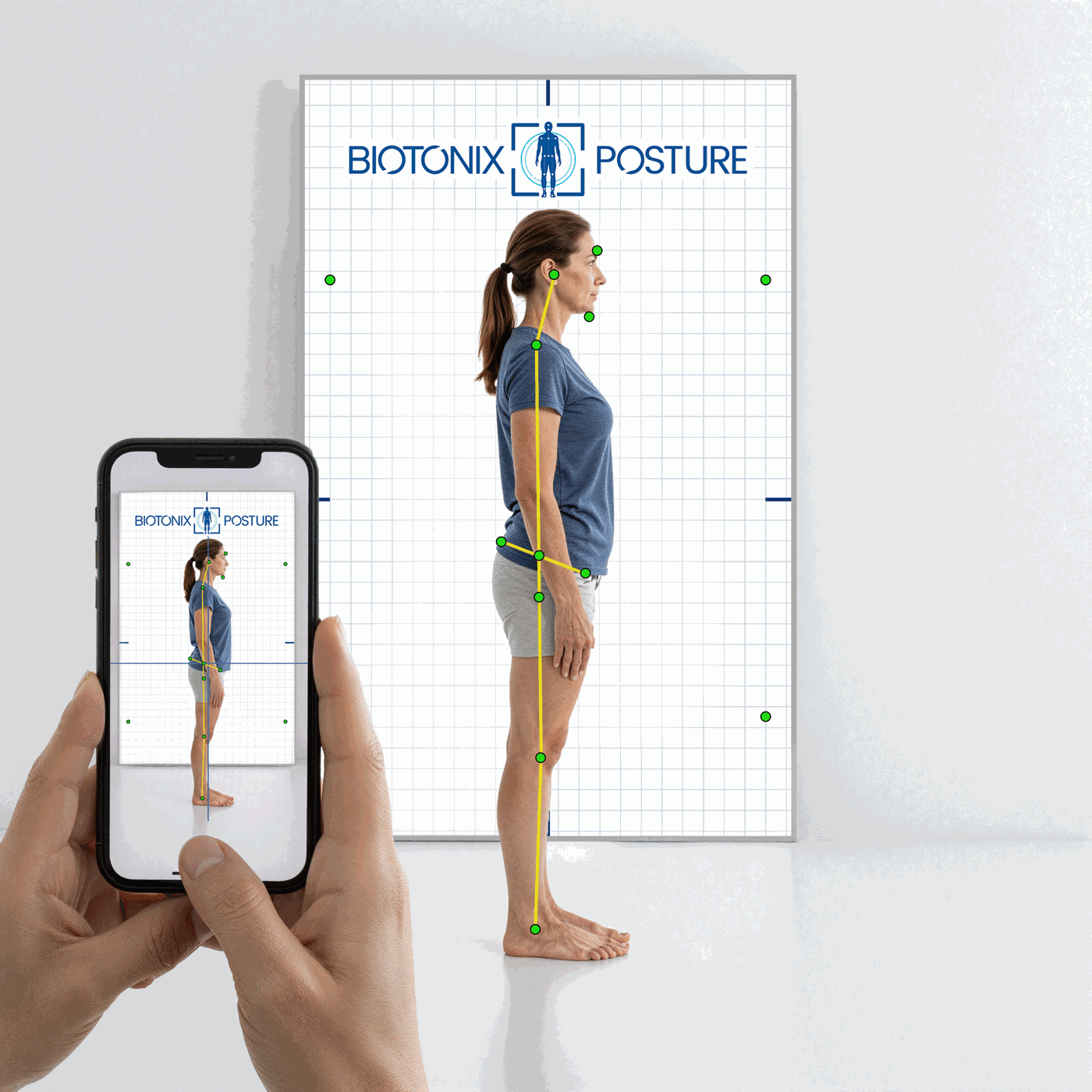
- Image acquisition. The practitioner takes three photographs of the patient (anterior, posterior and lateral views) standing in a relaxed, natural posture against a calibrated backdrop.
- AI landmark detection. The algorithm automatically identifies up to 39 specific anatomical landmarks without human intervention, and detects the four calibration markers on the backdrop to ensure metric accuracy.
- Data analysis & calculation. Once the landmarks are plotted, the software calculates the angular and linear deviations of body segments from the ideal vertical and horizontal plumb lines — objective, quantitative data on postural misalignments.
| View | Points | Key landmarks |
|---|---|---|
| Anterior | 16 | Glabella (FA02), acromions (FA05, FA07), ASIS (FA09, FA11), patellas (FA14, FA15) |
| Posterior | 14 | C7 spinous process (FP03), PSIS (FP07, FP09), popliteal cavity centers (FP12, FP13), calcaneus (FP17, FP19) |
| Lateral | 9 | Tragus of the ear (SD01), acromion (SD04), greater trochanter (SD09), transverse tarsal joint (SD11) |
III. Interpreting the Biomechanical Assessment Report
The report provides a multi-faceted view of the patient's posture. Examples below follow the sample case of Frank Marotte — see the January full assessment report.
- Visual data. The patient's photos with AI-detected landmarks overlaid — a clear visual representation of alignment.
- Quantitative deviations. The core of the analysis. Lateral view: Frank's head is 9.3 cm Anterior to the vertical plumb line and his pelvis shows an 11.7° Anterior tilt — clinically relevant, as angles greater than 15° or less than 5° indicate a tilt. Anterior/posterior views: a pelvic imbalance of 0.5° elevation Left (anterior view) but 1.3° elevation Right (posterior view) — a contradictory finding that is a classic sign of pelvic rotation, not a simple lateral tilt.
- Projected center of gravity. Illustrates how body weight is balanced over the feet. Frank's CoG is displaced 5.3 cm Anterior and 1.3 cm Right — objective data that correlates strongly with the anterior deviations and right-side translations in his lateral and frontal assessments.
- Biomechanical stress. The report translates deviations into tangible load using Moments of Force and the Effective Weight of body segments — a powerful patient-education tool. Frank's forward head posture gives his head an effective weight of 11.2 kg, up from its actual 7.1 kg: invaluable for explaining how posture amplifies stress on the cervical spine.
- Prioritized deviations. The system ranks the identified deviations and presents them as clear "Body Alignment Goals". Frank's report identifies two: "Your pelvis is shifted forward" and "Your back is rounded". These priorities form the foundation of the corrective program.
IV. From Interpretation to Action
- Automated exercise schedule. Based on the prioritized goals, the system generates a 10-week corrective program designed to balance opposing muscle groups. For Frank's forward-shifted pelvis, it prescribed strengthening for the back of the thighs ("Standing leg lift back") and stretching for the front of the thighs ("Quad stretch") — a direct link between deviation and corrective action.
- Professional oversight and customization. The generated program is a robust starting point, not a final prescription; your clinical judgment is crucial. Frank's note of "left knee pain" is critical — review the program with this in mind and modify or supervise exercises so they remain safe. His "High" activity level lets the system prescribe more challenging work: weighted exercises in Session 1, progressing to band resistance later.
- Follow-up and progress tracking. After the 10-week program, a follow-up assessment is recommended. The comparative report quantitatively tracks improvements between the January and July follow-up assessments, providing objective validation of the treatment's effectiveness.
V. The Comparative Report — Tracking Progress Over Time
The comparative report places two assessments side by side for direct quantitative and visual comparison of postural change. It is essential for validating a treatment plan and making informed decisions for future care. Frank's January-vs-July report is an excellent case study, showing a mix of significant improvement and complex adaptation.
| Measure | January | July | Reading |
|---|---|---|---|
| Center of gravity | 5.3 cm Anterior | 3.3 cm Anterior | Improved −2.0 cm |
| Shoulders to plumb line | 7.0 cm Anterior | 3.6 cm Anterior | Improved −3.4 cm |
| Effective weight, head + trunk | 61.9 kg | 56.3 kg | Improved (actual 50.1 kg) |
| Effective weight, head alone | 11.2 kg | 13.9 kg | Worsened |
| Head to shoulders angle | 10.1° Anterior | 16.5° Anterior | Worsened |
- Primary goal success (sagittal plane). Frank's CoG shifted posteriorly by 2.0 cm and nearly every segment moved closer to the ideal plumb line. The exercises targeting the sagittal plane — strengthening hamstrings, stretching quadriceps and pectorals — were highly effective. The core postural problem has been addressed.
- Emergence of a new pattern (frontal & transverse planes). While the sagittal plane improved, new asymmetries appeared: forehead, shoulders and umbilicus shifted to the Left of the plumb line, and the pelvic tilt and foot rotation inverted (pelvis from left-elevated to right-elevated; internal/external foot rotation swapped). This is classic postural adaptation — as a chronic misalignment corrects, secondary compensatory patterns can surface. Not necessarily a negative outcome, but a new clinical finding that requires a new treatment focus.
- Mixed results in biomechanical stress. Global torso load improved while forward head carriage worsened — a common occurrence when correcting the thoracic spine and pelvis initially exacerbates an unaddressed forward head posture. The next phase must specifically target the deep neck flexors and cervical extensors.
Clinical application of the comparative report
- Validate treatment. Use the quantitative data to show patients their objective progress. Celebrating successes — like Frank's reduction in anterior shift — is crucial for motivation and adherence.
- Identify new priorities. Evolve the plan: for Frank, the priority shifts from the sagittal plane to the new frontal-plane asymmetry (leftward shift) and the increased forward head posture.
- Educate the patient. Posture correction is a process. Use the report to show how the body adapts and how treatment adapts with it — frame new patterns not as failure, but as the next step toward optimal alignment.